
Introduction
One of the most common questions we hear at Yellowstone Motorsports is:
“How does a Honda Rancher 420 or Foreman/Rubicon 520 compare to the bigger 600–700cc machines from other brands?” On paper, it’s easy to assume that a larger engine automatically means more capability. But engine size is only one piece of the equation. One of the biggest factors people overlook is how efficiently that power gets to the ground.
And this is where Honda’s shaft drive transmission system has a real advantage.
Not All Drivetrains Are Created Equal
Most ATVs on the market use a belt-driven CVT (Continuously Variable Transmission) system. These systems rely on a rubber belt running between two clutches to transfer engine power to the wheels.
Honda takes a different approach.
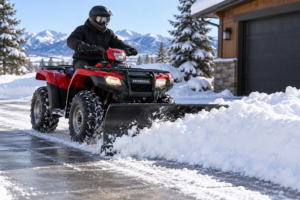
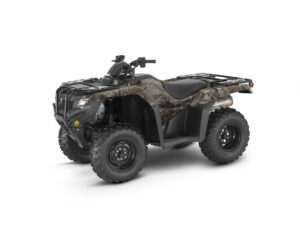
Honda ATVs like the Rancher 420, Foreman 520, and Rubicon 520 use a shaft-driven drivetrain paired with either Honda’s manual-shift transmission (ES) or automatic Dual Clutch Transmission (DCT).
Instead of relying on a belt, Honda uses gears and a driveshaft—similar to what you would find in a truck or tractor.
Efficiency: Where the Real Difference Shows
A belt-drive system can lose a noticeable amount of power through heat, friction, and belt slip, especially under heavy loads.
A shaft drive system transfers power through solid gears, which means:
- Less power loss
- More direct torque delivery
- Better performance under load
This means a 420cc or 520cc Honda engine often performs closer to larger displacement machines than you might expect.
Instead of needing more engine size to compensate for drivetrain loss, Honda simply delivers more of the engine’s power to the ground.
Consistent Power in Tough Conditions
Another advantage of Honda’s shaft drive system is consistency in real-world conditions.
Belt-driven systems can struggle in certain environments: - Deep mud
- Water crossings
- Heavy towing
- Slow technical riding
Under these conditions belts can: - Slip
- Overheat
- Require cooling time
- Wear out faster
A shaft drive system continues delivering power without relying on belt friction, which is why many ranchers, farmers, and hunters prefer it for work applications.
Durability and Low Maintenance
One of Honda’s long-standing reputations in the ATV world is durability.
The shaft-driven design contributes to that reputation.
Unlike belt systems that may require replacement over time, Honda’s drivetrain is designed for:- Long service life
- Minimal maintenance
- Consistent performance over years of use
For many riders, that translates to more riding and less wrenching.
- Real-World Capability
When customers compare specs online, they often focus on engine size alone. But in real-world use, capability is determined by a combination of: - Power delivery
- Drivetrain efficiency
- Reliability
- Traction and gearing
Honda’s approach focuses on usable, dependable power, which is why the Rancher 420 and Foreman/Rubicon 520 continue to be some of the most trusted ATVs on working properties across the country.
The Bottom Line
A bigger engine doesn’t always mean a more capable machine.
Thanks to Honda’s efficient shaft drive drivetrain, models like the Rancher 420 and Foreman/Rubicon 520 deliver power to the ground efficiently, reliably, and consistently—even when the work gets tough.
If you’d like to see how Honda’s drivetrain performs in person, stop by Yellowstone Motorsports and we’d be happy to walk y